
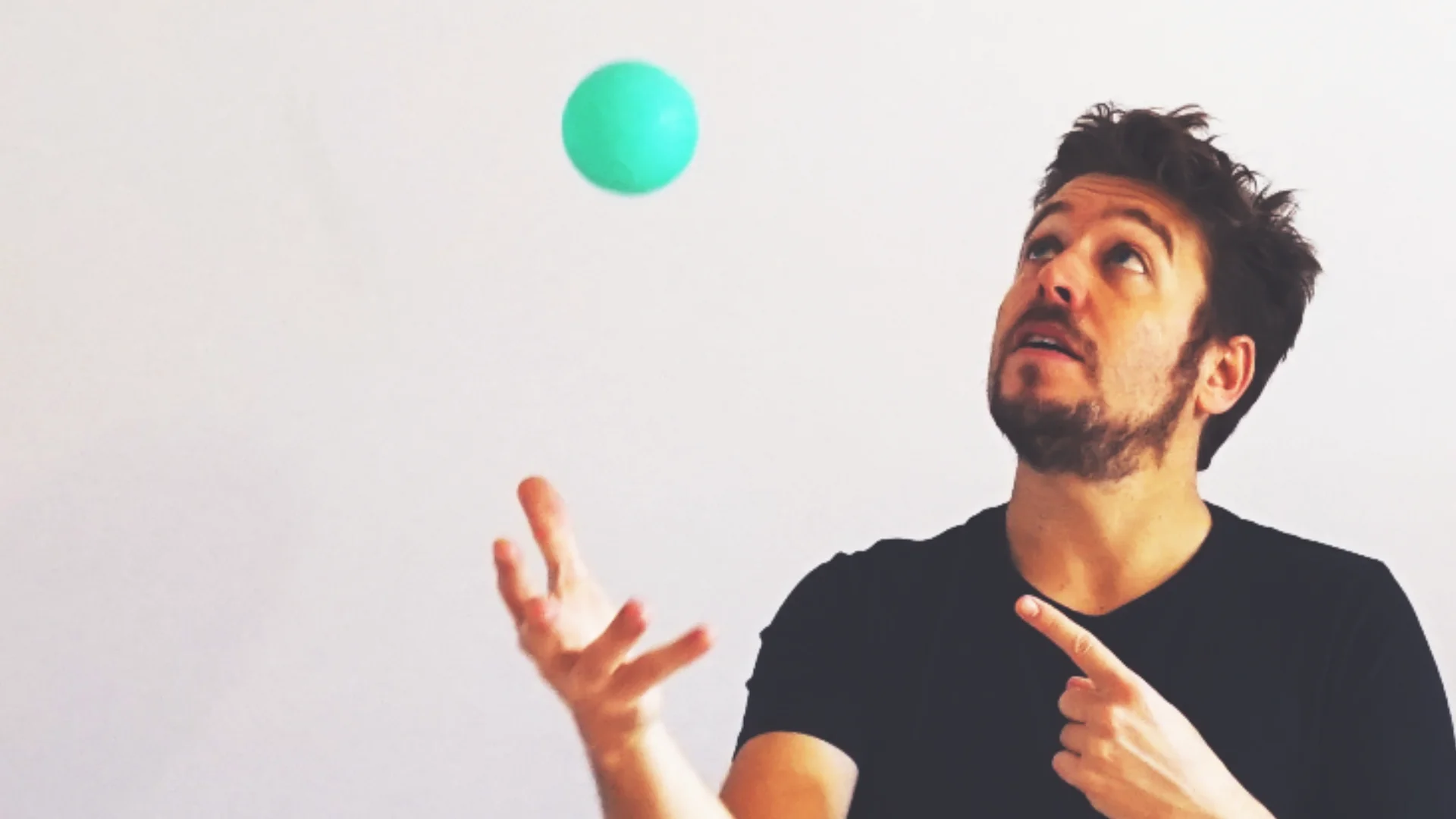
Over the past few days, while I was training outdoors, people have been coming up to ask me how juggling works, and after showing them I decided to write down the method I use in my workshops, which owes a great deal to Òscar Dieguez, juggling teacher at the Escola de Circ Carampa. The video covers the progression from one ball to three, with animated GIFs and the matching siteswap patterns for anyone who wants to go deeper into the structure of each throw.
11 essential exercises to lock in the 3-ball cascade
The method I explain in the video is the one I have tested in workshops and with people I have met along the way. It moves step by step, without skipping stages, because each exercise gets the body ready for the one that follows.
FAQs
About juggling 3 balls
How long does it take to learn to juggle 3 balls?
It depends on the person and on the time you put in. Some get it solid in a few days and others need weeks, and regularity counts for more than hours, because short sessions every day get you further than long ones spread far apart.
What mistakes do beginners make most?
Throwing too high or too low, moving forward chasing the balls and looking at their hands instead of keeping their eyes ahead. Many also grip the balls too hard, which makes a clean throw difficult.
Which balls work best to start with?
The ones that do not roll away when they land and that have a weight suited to your hand. Beanbags or the BBX from Play Juggling work very well for the first steps, and if you want more on this there is the article on choosing your first set of balls.
Can I learn with no previous experience?
Yes. The first step is learning to throw and catch one ball cleanly before adding any more, and you can do that exercise today, since it asks for no previous coordination, only following the progression patiently.
How to juggle step by step with GIFs and siteswaps
Each exercise has its animated GIF and its matching siteswap pattern. Siteswaps describe the mathematical structure of each throw and help you understand why each exercise prepares the next one.
One-ball exercises, the foundations
Everything starts with a single ball. The posture and the rhythm you set here decide the quality of everything that follows, elbows bent at 90 degrees, palms up and eyes ahead instead of on your hands.
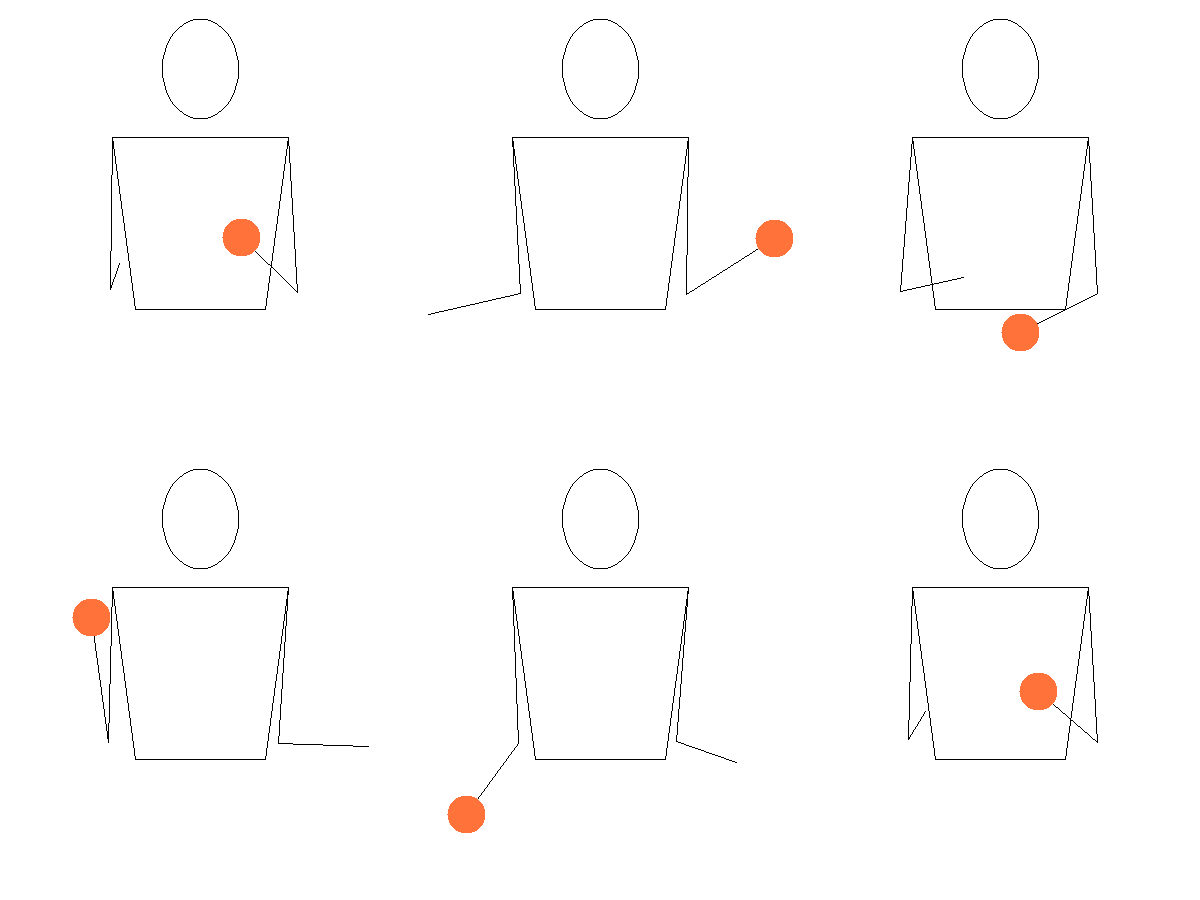

- Hold a single ball in your dominant hand, with your elbows bent at 90 degrees and your palms up.
- To throw the ball, move your forearm upwards, keeping the wrist and the whole arm out of it.
- Keep your elbows by your hips. The throw should reach eye level at its highest point and should be angled to land in the palm of the non-dominant hand, which is waiting. When you catch it, let the ball drop into your hand without reaching out for it.
- Adjust the position of your body if the throw comes out off centre.
Two-ball exercises, the basis of the exchange
With two balls you learn the exchange, the moment when the two balls cross, which is the fundamental movement of any cascade.
Practise the basic exchange with two balls and then try to keep the pattern going


- Take two balls of different colours, one in each hand, and start by throwing the first one, the orange, from your dominant hand.
- When the ball reaches the highest point of its path, throw the second one, the yellow, from the non-dominant hand and underneath the first. The two paths need to be set towards the hand that will catch each ball, because if they are identical the balls collide in the air.
- Catch the first ball, the orange, with the non-dominant hand, and the second, the yellow, with the dominant one.
Now try starting with two balls in one hand
Once you feel comfortable with the exchange on both sides, you are ready to take on the cascade.
![Two-ball exercise, siteswap [32]0320 - How to juggle 3 balls - troposfera.xyz](https://troposfera.xyz/wp-content/uploads/2022/12/2-ball-didactic-exercices2303202-how-to-juggle-3-balls-troposferaxyz.gif "Com fer malabars amb 3 pilotes 6")
![Two-ball exercise, siteswap [32]0330330320 - How to juggle 3 balls - troposfera.xyz](https://troposfera.xyz/wp-content/uploads/2022/12/2-ball-didactic-exercices2303202-x-3-how-to-juggle-3-balls-troposferaxyzgifgif.gif "Com fer malabars amb 3 pilotes 7")
Three-ball exercises, here we go!
Before trying to keep the 3 balls up for as long as you can, do just 3 catches, and once those are solid try 5. Remember to start with a different hand each time.
![Three-ball exercise, siteswap [23]3322 - How to juggle 3 balls - troposfera.xyz](https://troposfera.xyz/wp-content/uploads/2022/12/3-ball-didactic-exercices233322-how-to-juggle-3-balls-troposferaxyz.gif "Com fer malabars amb 3 pilotes 8")
![Three-ball exercise, siteswap [23]333322 - How to juggle 3 balls - troposfera.xyz](https://troposfera.xyz/wp-content/uploads/2022/12/3-ball-didactic-exercices23333322-how-to-juggle-3-balls-troposferaxyz.gif "Com fer malabars amb 3 pilotes 9")
Take three balls, two in your dominant hand and one in the other.
- Hold the two balls so that you take one, the orange, with your thumb, index and middle finger, and the other, the green, with your ring finger and little finger.
- Throw the first ball, the orange, from your dominant hand.
- As in the exchange, throw the second ball, the yellow, from the non-dominant hand when the orange is at eye level.
- Catch the orange with the non-dominant hand.
- When the yellow is at eye level, throw the third ball, the green, from your dominant hand. It is the same exchange, only on the other side.
- Catch the yellow with the dominant hand, close the pattern and start again from the other side.
Once you have that solid, you can try adding more throws and catches, as I said at the beginning of this section.
All the animations were made with JugglingLab. If you want to choose the right balls to practise with, there is the article on your first set of 3 balls, and if you would rather make your own, here is how to do it.
You must be logged in to post a comment.